Uncategorized

Glimpse of Grace

My dad loved thunder storms, especially, it seemed, at night. I remember as a child sitting on his lap as a real “rumbler” rolled through from the west. I’ve often wondered why he liked them. He seemed to find a certain peace, especially in the summertime.  If I ever asked him “why”, I don’t remember his answer. He entered the Church Triumphant several years ago. But still, I wonder.  Was Dad fascinated by the wind or the lightening? Perhaps he was reflecting upon life’s hard knocks, the storms and disappointments that he confronted and largely overcame? Maybe he was having a “Walter Mitty” moment, imaging himself back in the navy standing on the deck of a ship cutting though the North Sea.  I don’t know why, but I do know that I was afraid.     
        The disciples knew what it was like to be afraid. One night they were taking Jesus to the other side of the Sea of Galilee.  Suddenly a storm arose. They were sure that they were going to die. They desperately looked for Jesus and found Him, asleep, in the stern of the boat!  “Don’t you care?” they cried.  I can understand their fear. I can imagine their desperation. We’ve all been afraid. We’ve all wondered at one time or another, whether we want to admit it or not, “Don’t you care?”
        “Be still,” Jesus commanded. And, just like at the Creation when God brought silenced the chaos, the wind died, the waves calmed, order was restored, and the disciples looked at each other, wondering, “Who is this man?”
        “Why are you afraid?” Jesus asked. The question cut to the heart of the matter. It cuts us, too.
         Overwhelmed. Swamped. Afraid. Life has a way of making us afraid. “Don’t you care?” we ask. Yes, He cares. Jesus does care, and if He cares, then we know that God cares.
         Therein lies the good news, the glimpse of grace. Sooner or later, in His own time, always at the right time, He “stills the storm.”
 

Standard
Uncategorized

Glimpse of Grace in a Fourth Grade Teacher

I knew that my oldest daughter was going to be an educator when she came home from school one afternoon and announced that she wanted a pair of red canvas tennis shoes “like Mrs. Hall’s.” Mrs. Hall was her fourth grade teacher. She idolized Mrs. Hall. When we asked her how her day at school went she would begin by telling us something that Mrs. Hall said or did. Often we would hear “teaching” her dolls when she thought no one was listening or noticing. If imitation is the highest form of flattery, Mrs. Hall should have been quite flattered.

     Imitation is defined as copying the actions, mannerisms, appearance or speech of another, to mimic. At some point in our lives, we all imitate someone or even several “someones.” Often this is done unconsciously. Sometimes it is done consciously.  It is through imitation that we “try on” different personas. We learn how to act and even think. Boys often imitate their father, older brother or uncle in the early years and perhaps a coach as they grow older. Girls mimic their mother or sister or aunt, teacher or coach.  If the person being imitated realizes what is going on, they may become an intentional mentor, showing their young protege “the ropes.”

     We learn through imitation. Imitation is how we figure out who we are or who we are not. Slowly we find ourselves being changed, transformed, shaped into the individual we are today. This is true of each and every one of us. Charles Barkley’s protests aside, Johnathan Vilma hit the nail on the head when he said that whether we like it or not, “we are role models.” Someone is always watching us, studying us, judging how we measure up. It may be that we do not measure up. In that case, let’s hope that if we can’t be a good example then we’ll be a good warning!

     In his first letter to the Corinthian church, the Apostle Paul encouraged the community to “imitate me as I imitate Christ.” 11:1) Paul was not being arrogant, though many read his comment as such. He simply knew that following Jesus was not easy. Jesus cut a “new path”, a difficult path.Jesus said things like, “Whoever would be my disciple must pick up the cross and follow me” and “Whoever wishes to save their life, will lose it, but whoever loses their life for my sake and the Gospel’s will find it.” The Corinthian community had to learn how to follow Christ and to see the world differently. They had to learn not only what Godly love was but to live that love with each other as well as their enemies. 

     If we could all be a “Mrs. Hall” in our Christian discipleship the world would be more like the peaceable kingdom that the prophet Isaiah saw centuries ago. And each one of us would be a living glimpse of grace.

Standard
Uncategorized

Glimpse of Grace on a Playground

Years ago, when my daughters were young, I spent many warm summer mornings playing in a park near our house with the youngest of the two while the older one was busy mastering First Grade.
One morning I knew it was time to go home for lunch and a nap when my daughter started staring off into space while swinging. As was often the case, whenever it came time to go home, her legs were just “too tired” to walk.  Rather than debate or cajole, I scooped her up in my arms and headed home. She was fading fast. I could tell because she started her “nap-time-settling-in” routine. She began to rub her sweaty brow into my shoulder. Not wanting her to fall asleep before lunch, I whispered in her ear those magic words that makes everyone’s ears perk up. “I’ve got a secret,” I said. Her head popped up off of my should as she asked, “What is it?” Busted! I didn’t really have a secret.  I was desperate. I took a shot in the dark. I said the first thing that popped into my mind. “I love you.”
That wasn’t really a secret but I hoped that it would suffice for the moment. But, no. Now alert, she pressed on. “Why?” she demanded.
“Why?” Boy, I should have seen that one coming since it is the favorite question of most three year olds.  But I didn’t. I didn’t see it coming. God is gracious, though.  Without missing a beat, without even thinking, I replied, “Because you’re mine!”
Later that day, and many times since then, I have thought of that little scenario played out so long ago. I’ve pondered her question and my response. I didn’t need to think about my answer. It came out naturally, spontaneously. And in that little exchange between a father and his sleepy little girl we are reminded of the heart of the Gospel embodied in Jesus of Nazareth. God loves us. Why? Because we are His.

Standard
Uncategorized

A Glimpse of Grace in a Garbage Can

Each Tuesday evening I roll our large plastic garbage can out to the curb to be picked up early Wednesday morning by a sanitation crew.  It is something that I don’t look forward to doing and occasionally I forget to do it. This usually results in a problem by the time the next “garbage day” rolls around, especially if I forget the week before a major holiday like Thanksgiving or Christmas! Sometimes the can is so close to overflowing that I can barely close the lid. At other times there may be only a couple of tall kitchen bags of garbage in the bottom of the can. During the hot months of July and August I am careful when I open the lid to add more garbage. The putrid smell can literally take your breath away, especially if diapers are involved!
    One winter evening, as I struggled through three foot snow drifts to move the can from the back of the back door to the curb, I got to thinking about what my religious tradition calls “The Confession of Sin.” It is a time  set aside in our weekly worship service when we reflect upon the brokenness of our lives. and the world around us.  During a time of silent prayer I remember the promise that I had good intentions of keeping, but simply didn’t,  the unkind word spoken, the email that I wish I hadn’t sent, moments of callousness, “compassion fatigue”–the guilt of not being willing to give any more of myself. After the time of this silent reflection, I join my fellow worshipers in a more formal prayer of confession of sin. This time the prayer is for the brokenness of the world and the part that we play in that brokenness, no matter how small that part may be.  After the Confession, comes a word of grace, the Assurance of Pardon. It always ends with the words, “Believe the good news of the Gospel, in Jesus Christ, you are forgiven.”
    This confession of sin, when it comes from the heart, leads to a moment of grace. It allows us to unload all of the garbage of our lives, all of the stink and rot, and to place it on the “curb” for God to pick up and carry away. At these times, confession truly is “good for the soul.”
    Years ago I read a sermon entitled “My Heart, Christ’s Home”. Delivered by the Rev. Robert Boyd Munger at the First Presbyterian Church of Berkley a generation and a half ago, over the years it has been widely distributed around the world. The sermon is an allegorical story of how when one person invited Christ into his home of his heart a slow transformation that took place one day at a time.  In the closing scene of the allegory, the author tells of smelling a strong pungent rotten oder coming from a hidden closet conveniently tucked away in a forgotten part of the house. It was the one place that he did not want Christ to go for it contained all of his secrets, all of those things that the person was ashamed of. They may have been locked away but they were far from forgotten. Jesus looked at the man and understood.  He simply asked for the key to this final door of the man’s heart. He would clean this mess Himself. 
    We need to take out the garbage of our lives at least once a week, whether we want to or not. This is especially true in our spiritual lives. No doubt, we will produce more garbage before our time here is done but that doesn’t mean that we have to let it accumulate around us like a hoarder on some television show. There is Someone who will help us take our garbage to the curb,. All we have to do is give Him the key.

Standard
Uncategorized

Glimpse of Grace in a Facebook Mesage

The invitation came as a complete surprise through a Facebook message. A few days earlier I let a mission-mentor-friend know that I was home after a visit to Wana Wa Mola in Mombasa, Kenya. My mentor-friend helped arrange my initial exploratory visit to East Africa some four years earlier. A few days later he responded and asked a very simple question. Did I want to attend the 62nd annual National Prayer Breakfast in Washington, D. C.? The possibility, let alone the likelihood, had never crossed my mind, not even in my wildest dreams! “Yes.”
    First organized in Washington, D. C. in 1942 by the members of Congress, members of the United States Senate and House of Representatives gather weekly for a time of food, fellowship and prayer. Politics is left at the door. Members, regardless of party or voting record, or region of the country, encourage, support and pray for one another. And then, each February since 1952, they host the National Prayer Breakfast which brings 3000 representatives from around the world together at the International Ballroom of the Hilton Washington. Every President since Dwight D. Eisenhower has attended the breakfast, and every President has spoken about the importance of prayer in his life.
    This year’s hosts—Representatives Louie Gohmert (R-Texas) and Janice Han (D-California) set the tone and the mood early. Positioned at opposite ends of the political spectrum with seemingly little if anything in common, they displayed the good natured banter and kidding that comes from deep friendship and mutual respect. The thing that united them–and everyone who sat on the platform, regardless of their spiritual background–was Jesus; the Christ to Christians, a major prophet to Muslims, and honored by people of all faiths. And indeed, all faiths were represented at this breakfast.
    Flying from Washington, I mulled over my experiences. I dined with people whose faith stories were far greater than mine. I shared a bagel with a man from Nepal, passed a pat of butter to a Native American social worker from Minnesota, joked with a diplomat from Great Britain, learned about how a major cookie manufacturer met his wife, marveled at the energy of an ER doctor who also provided foster care for difficult teenage boys, and listened to a college student from Kosovo talk about his homeland. I was waaay out of my league. But then, isn’t that a definition of “grace”? Being out of your league? Not being deserving?  Grace isn’t something that we’ve earned. Nor is it something that we can buy or make. Grace isn’t about us. It’s about the One who gives. It is a gift, a true gift with no strings attached.
    It didn’t take an invitation to a National Prayer Breakfast to make me aware of grace, but it did remind me how “grace-full” I am.  How truly “lucky” I am. Grace touches me every day; as I open my eyes in the morning of a new day, when a grandson runs to me as I pick him up from school, or another one calls to tell me that he got his first base hit. Grace hangs on my refrigerator door in the illegible handwritten notes and cards sent by my granddaughters. It sits on my desk in a calendar sprinkled with family pictures from the past year. I experience it on Sunday mornings when a child wanders into my office for a cookie or a neighbor invites me over for a Downton Abbey dinner party knowing that I’m not a fan but that I would be eating alone that evening. It touches me through the touch of a spouse who loves me even when I’m not the least bit lovable, and the friend who drove me home from an emergency room at 3 in the morning when no one else was around.
    Ol’ John Newton got it right. “Amazing grace, how sweet the sound, that saved a wretch like me.”

Standard
Uncategorized

Glimpse of Grace While Waiting for a Delayed Flight

As I write this I am sitting in an airport terminal waiting for my next flight. Our departure is delayed because of late arrivals due to weather conditions and, I am sure, other complications of which I am not aware. These delays can drive us crazy.
We are not a society that likes to wait. The Disney parks have “fast tracks” for we who are impatient. Grocery stores have “express lanes” for shoppers with a limited number of items. Expressways have “express lanes” for people with a certain number of passengers. Toll booths have “X-Press” booths for those of us with “I-Passes.
While I am as impatient as the best of them, I try to use these delays as a form of “spiritual discipline.” “Wait for the LORD,” the Psalmist advised (27:14). I remember reading a sermon by the Rev. Dr. Gardner Taylor in which that eloquent old preacher said that the good Lord may not show up when you expect, “but He’s never late.”
So, I try to relax as I wait, watching people rush to their various gates and reflecting upon what glimpse of grace God has in store for me next!

Standard
Uncategorized

A Glimpse of Grace in a Nighttime Snowfall

A gentle snow is falling tonight in my part of the world. It is a shoveler’s delight and a child’s disappointment. Light and fluffy, it is easy shoveling but difficult, if not impossible, to pack into a snowman or a snowball. Before the night is over weather forecasters say we’ll have accumulated four to six inches.
    At night you can only see the falling snow as it passes through the beam of a nearby streetlamp. But, if you stand outside, you can feel it strike and melt upon your face. You can see it cover the lapels of your coat and feel it go down you neck. Inside the house I take off my stocking cap. It is covered with rapidly melting snow.  
    Sitting by my window I see it slowly cover the ground hiding a discarded bottle here, a blowing discarded wrapper there. Slowly the world is transformed. It becomes “clean”, “pure”, blanketed in white. Earlier, while I shoveled my sidewalk, I thought about something the prophet Isaiah said. “Come now, let us reason together, says the Lord: though your sins are like scarlet, they shall be like snow; though they are red like crimson, they shall become like wool.” (1:18, my emphasis)
    A winter’s night. A gentle snowfall. A glimpse of grace. Amazing, eh?

Standard
Uncategorized

Glimpse of Grace in a Cemetery

As a minister I am frequently in cemeteries. When officiating at a graveside service I usually arrive a early enough to wander around and read the various markers. Rather than finding this to be depressing, I find the experience to be strangely comforting. For me, it’s a good “reality check.” Here are a few lessons that I take from these walks.
     Lesson One:  From dust you come, unto dust you shall return. (Genesis 3: 19) The story my be apocryphal  but I once read that the late Charles DeGaulle and his wife had a special needs child. As was often the case in the 1950s, the child died at an early age. On the way from the church to the cemetery DeGaulle and his wife sat in silence in the back of the limousine. As they turned into the cemetery lane DeGaulle’s  wife broke the silence and saying that she wished that their little one could have been like everyone else, meaning “normal.” DeGaulle didn’t respond at first. He continued to look out the window, staring at the markers they passed on the way to the final resting place for this precious child of theirs. When the limousine stopped DeGualle, still looking out the window with a far away look in his eyes said, “Well, now she is. Now she is like everyone else.” In the end, we are all alike. We are all special. We are all precious in the sight of God..
    Lesson Two: I find mausoleums depressing. I have been in some beautiful mausoleums over the years but I have also seen many that have outlived their endowment. They leak and crumble and be a shadow of their former self.
    Ultimately, everything that we build crumbles. Jesus got crossways with religious authorities in Jerusalem when he reminded them that the Temple of which they were so proud would one day be nothing more than a pile of ruble. Even without the intervention of the Romans, this would have been true. Nothing we build lasts forever. The grandest cathedrals become naked skeletons and then a pile of stones. The things of this world are not permanent. The sooner we learn this, the better off we will be.
    Lesson Three: Sooner or later we are faint shadows in history. The day will come when no one will remember us.
    About a year ago I walked through an old cemetery adjacent to a small rural congregation I first served. At the highest point of the cemetery there is marker that rises above all of the other markers. It stands there majestically like the Washington Monument rises into the D. C. skyline. The person buried beneath the marker died in the 1830s. I recalled as a young minister still being able to read the name, the date of birth and the date of death as well as a verse or two of Scripture etched on the stone. But when I visited this cemetery this time, all of that was gone. The winds and rain and lichen had taken its toll. Whoever was buried beneath the stone was no longer legible.  
    So it will be for us. I know only a couple of stories of my paternal great grandfather and fewer still of his father. That’s about as far back as my family legacy goes. I can’t even go back three generations with my maternal grandparents. Only a handful of people are remembered a thousand years after they completed this part of life. Why do we think that it will be any different for us?
    The wisdom of my faith reminds me not to worry so much about the future or try to hold on to past memories. Instead, I am called to live, as best as I can, in the present. That is hard for me because I am a bit of a dreamer and a romantic. But the present is really all that I have. It is all that you have, too. Everything else is ethereal, imaginary, not really real.  But the Present, now that is something else. That’s what it is called the Precious Present!
    So, let’s not take ourselves so damn seriously. Lighten up. And don’t worry so much about making memories for others. Trust me, they will have their own memories of us. Love, laugh, cry, feel, enjoy this thing called life. If you can do this, you will not only see but you will be a glimpse of grace.

Standard
Uncategorized

Glimpse of Grace from a Cracked Chalice

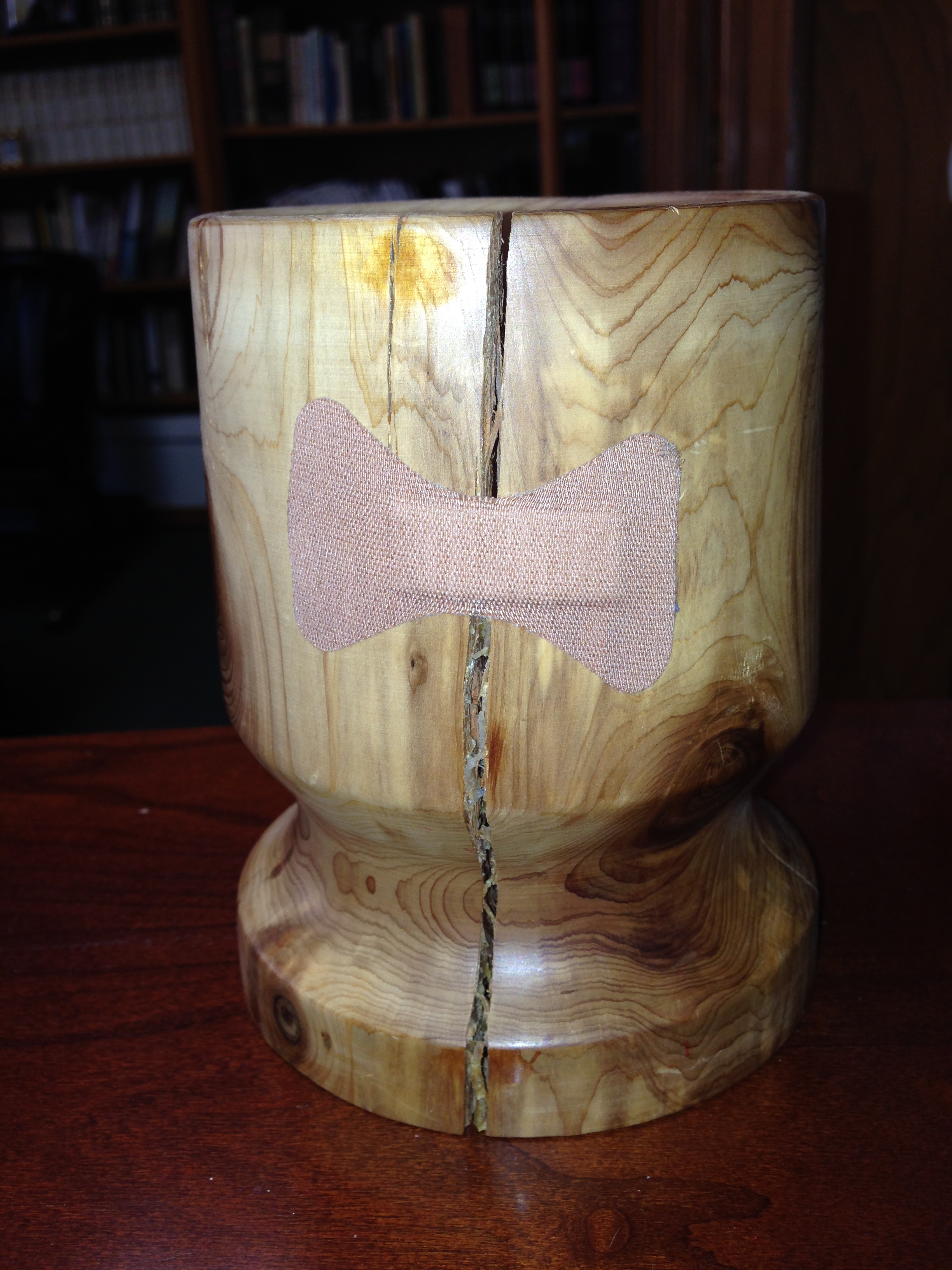
I have a wooden cracked chalice in my office. It was a gift given to my wife and I by a parishioner on Easter morning in 2001. The craftsman who made dated the bottom of the chalice and signed his name.
    It wasn’t cracked when he gave it to us but within a few months, the chalice dried out and cracked. When the master woodworker saw it he was embarrassed. He wanted to make us a replacement but we said no. We rather liked the cracked chalice. One day he snuck into my office, where it had taken up residence and added a bit of humor to the chalice. Over the crack he placed a butterfly bandaid! I liked the added touch and never removed it. The chalice still sits on my shelf. I still like it.
    God likes broken things. More than that, God is connected to the broken in a very special way. In the 147th Psalm we are told that God mends “the brokenhearted.” The old prophet Isaiah announced that the Spirit of the LORD was upon him because God anointed him “to bring good news to the poor” and “to bind up the wounds of brokenhearted.”
    The Almighty uses broken things to reveal the divine glory. Soil is broken so that seed can be planted. Grain cracked before it is made into bread. Grapes are crushed before they are made into wine. And the One whom Christians call “Lord” and “Savior” was broken to take away the sin of the world. Cracked grain. Crushed grapes. Bread and Fruit of the Vine. The Risen Lord. Body and the Blood, broken and shed for you and for me.  A glimpse of grace. Image

Standard
Uncategorized

Glimpses of Grace from Looking at Clouds

    When I was seven or eight years old I would often lay outside in my back yard on warm summer days with the two little neighbor girls, Nancy and Carol. We would spend what seemed like hours looking at the white puffy clouds floating by overhead. And we would see things; little hunched down rabbits and Jack and the Beanstalks’ giant, floating dragons and sleeping old men with long white beards. We could almost hear them snore if we listened really hard.

     Sometimes we had to point out what we saw to each other because we weren’t always looking in the same place or at the same angle. Often, as we tried to point something out,  the images would be transformed from something kind and gentle into something frightening and horrid. We thought that this was magic of some kind, or maybe God drawing pictures in the sky. Maybe it was the Almighty’s way of speaking to us. None of us had ever heard God speak, of course, but maybe, we thought, He spoke to us in the clouds.   

     As I grew older I knew that “our” clouds were actually “cumulus” clouds and nothing more than collections of water droplets. The name cumulus came from a Latin word that means “heap.” Those particular clouds were a sign of fair weather. I also learned about air currents, and how they moved clouds across the sky. There was nothing magical about the cloud transformations. It was simple science.
    But God, well now, that was and is another matter all together. As I have grown older I have become convinced that God speaks to us, more often then not, through the circumstances and events of our lives. Often we don’t understand what is being said at the time but there are occasional times when we recognize what He is saying.  And, in my childlike moments when all things are possible, I still hold on to the belief that God spoke to me in those clouds of long ago. The Almighty graced me with a glimpse or two.
    One glimpse, one insight, is that a lot in life depends upon our perspective. Often we don’t understand something or someone or see things exactly the same way as someone else does because of our perspectives are different, born out of different circumstances and experiences. This does not mean that one of us has to be right and the other wrong. It does mean, though, that we have a lot to learn from each other.
    The other glimpse is the relentlessness of change. As the clouds changed their shapes because of winds in the atmosphere, we too find that the world has changed due to the winds of time. We constantly change our minds about certain things in light of new information, circumstances, situations and events. I pity the person who is afraid to change their mind about something. Survival is born of constant change. Those who either cannot or will not change are doomed to extinction.

Standard